Showing posts with label war. Show all posts

Sunday, 21 August 2016

A battle with the AIF

The prompt for this (third) week of the NFHM Blogging Challenge refers to some of the significant battles of two World Wars that will be remembered during this month. But, not all of the battles that took place in 1916 and have shaped our family histories across generations were military actions. There were personal battles, bureaucratic battles and domestic battles taking place on the Home Front that were to prove equally influential.

On the 19th of August 1915, Recruiting Train 3 returned to Brisbane1 via the North Coast Line after a final major rally at Gympie intended to attract new recruits for the Expeditionary Force.

In the next few weeks, Queenslanders began to get an inkling of the tragedy occurring in Turkey. On 7 September, the Brisbane Courier carried a small item2 referring to heavy Australian losses that hinted at (what we now know as) the disastrous attack on Hill 60 (Kaiajik Aghala) without any explicit reference.

So it was not surprising that by the middle of September 1915 there would be a surge in the number of men presenting themselves at Victoria Barracks eager "to do their bit" One might not have expected to see Alfred Edward Noyes among them. He was no youthful bushman in search of adventure but a 33-year-old former timber-getter tending a small fruit farm at Palmwoods to support his wife Emily and their six surviving children.

Nevertheless, on 18 September 1915, Alfred swore that he would "well and truly serve our Sovereign Lord the King in the Australian Imperial Force from [that day] until the end of the war" and Dr. Cameron of the Army Medical Corp declared him fit do so (although he noted a "large scar on the front of his right leg"). The group of new recruits was assigned to A Company, 7th Depot Battalion at Enoggera for their basic training3.

Alfred's first few months in the Army must have been unexceptional. The only entry on his record concerns a 5/- fine for a bout of drunkenness to celebrate the New Year. The same period was much harder for Emily. As she wrote in a letter to confirm a meeting with an Army Chaplain, "all his interests on the farm are going to rack and ruin [...] the man he left to look after it has cleared out [...] I have five young children that prevents me from doing anything". She apparently felt it would be too much to add that the twins had celebrated their first birthday after Alfred enlisted and that Doreen (apparently not counted among the "young" children) was not yet 11.

On 20 January 1916, the recruits were deemed ready to be assigned to their eventual unit for final training before departure. Alfred was included in the 17th Reinforcements for the famed 9th Battalion with whom he moved to Exhibition Camp at Bowen Hills. Given the need to ensure that the available weapons and ammunition went to the troops at the Front, much of basic training in 1915 was undertaken with broomstick "rifles". At Exhibition Camp, Alfred was issued with a real SMLE service weapon which would reveal a flaw in his readiness for embarkation. Not only was Private Noyes unable to fire the rifle successfully, he could barely handle it. His difficulty was attributed to a "stiff wrist".

Meanwhile Emily was continuing her campaign to have her husband sent home. She wrote that "An examination of his arm and leg should convince anyone that he is not fit for active service". It seems that the interests of an angry wife and a frustrated company commander coincided and, on the 8th of February, a Medical Board was convened to determine whether Alfred should be discharged as medically unfit.

When questioned, he freely acknowledged that a log had fallen on him at Killarney in 1902 crushing his right side. He had since had two operations on his right arm but the wrist was still twisted. The official medical examination identified "atrophy of right forearm ... deformity of wrist ... loss of bone ... adhesions between ulna and radius preventing rotation". The professional opinion of the Board members was that this represented a 50% reduction in the man's capacity for earning a full livelihood in the general labour market.

On 21 February 1916, Alfred Noyes' war ended. He was discharged and caught a train back to Palmwoods to tend his pineapples (and to extend his family when young Edward Alfred was born in the following January).

It seems probable that even after her husband's return, Emily continued to be responsible for most of the heavy work. Eldest daughter Doreen had strong recollections of "looking after the little ones" while her mother undertook farm work that possibly contributed to her early death at just 39 years old in 1927.

It was not just on the Western Front, that there were extended battles from which no real winner would emerge.

References:

  1. Queensland State Archives: Police Commissioner's Office; 16865 Correspondence 1861-1987; 2041776, Correspondence about advertising and arrangements for the Recruiting Train (1268M 50); digital image; ; accessed 19 August 2016
  2. 1915 'THE DARDANELLES.', The Brisbane Courier (Qld. : 1864 - 1933), 7 September, p. 7. , viewed 21 Aug 2016, http://nla.gov.au/nla.news-article20068160
  3. National Archives of Australia: Australian Military Forces; B2455, First Australian Imperial Force Personnel Dossiers, 1914-1920; 7999844, NOYES ALFRED EDWARD; digital image; ; accessed 19 August 2016

Thursday, 15 August 2013

A sad tale retold

Family historians always get excited about finding a new source. At worst, you can cite some further support for information that you already have. At best, there may be completely new evidence to add to the narrative of your ancestor.

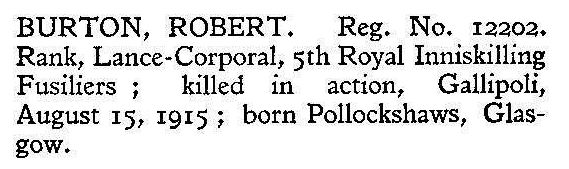
As the anniversary of the death of Robert Burton at Suvla Bay approached, I have been reviewing what (little) I know about his military career. In the course of that search, I came upon a report of IRELAND’S MEMORIAL RECORDS 1914-1918: Being the Names of Irishmen Who Fell in the Great European War 1914-18

This very beautiful, but very expensive, publication was described as being a "Roll of Honour listing over 49,000 of Irish birth or residence at the time of death, who served and died during the Great War, compiled by The Committee of the Irish National War Memorial with Decorative Borders by Harry Clarke". In the early 1920s, £5,000 of Ireland's War Memorial funds was spent collecting the records of over 49,000 fatal casualties and publishing them in eight volumes. The men and women commemorated either served in Irish Regiments or were born in, or resident in, Ireland at the time of their death serving with units from Britain and its empire.

For those without the several hundred euro required to purchase a hard-bound set of the books, digital images can be viewed on Ancestry or FindMyPast. There I found the entry for Robert Burton. Sadly, it provides no new information.

A young man marched away bravely in search of adventure; never to return. However exquisitely the page may be decorated, everything else is emptiness.

Saturday, 10 August 2013

An angel remembered

Jack Wilkinson's active service with the 15th Battalion in 1919 lasted just six months, but it created a connection that would endure for the rest of his life.

After the war, many returned men resolved to preserve the bonds forged in battle through clubs or associations. The troops of the 15th Battalion had used "Angels" as a code word in the trenches and so named their group the Angels Remembrance Club . Jack was an enthusiastic member and frequent office bearer over the next quarter century.

The Angels Remembrance Club was noteworthy not only for its work in supporting those who came home but also for the vigour with which they fought to protect the memory of those who did not. When the observance of Armistice Day waned in the late 1930s, it was the Angels (with Jack as Secretary) who strove to maintain its importance in the public eye. They were vocal critics of any plans for military reorganisation that might lessen the perceived stature of the 15th.

Many ex-service organisations held annual dinners during Exhibition Week when members who had returned to their homes in the bush might be in town. But the most significant gathering of old soldiers was always for Anzac Day.

Jack Wilkinson died on 24 April 1944 and some might say that he missed Anzac Day. Few who did attend the march would have noticed that the men of the 15th Battalion gave a second salute that day; and fewer still would have recognised its significance. In its report of the Parade on the following morning, The Courier Mail showed that some connections can never be broken.

Friday, 9 August 2013

Which Sergeant?

The image of Jack Wilkinson that illustrated the post about his Military Medal is a detail taken from a postcard that he had made in England on Boxing Day 1917 and sent home early in the new year.

On the back he wrote "Snap of self and my pal Larry ...". Of course, the family members who were delighted to receive news that he was safe and well did not need him to add "that is me on the left" because they would all recognise him immediately. A family historian working almost a century later needs a little help. I have no other photograph that I know to be him.

Fortunately, at the time of enlistment, the AIF recorded and preserved a range of physical characteristics of each man. So I have a sworn statement from Captain Cummins that Jack was 5 feet 5 inches (165 cm) tall and 190 pounds (86 kg).

Measurements made on the postcard indicate that the ratio of the heights of the two pals outside the Sergeants Mess was 17:19. So Larry must be either less than 150 or more than 180 cm tall.

Since the Australian forces did not ever recruit bantam units, Larry must be the towering 6 footer and cousin Jack is indeed the square-built iron worker on the left.

Thursday, 8 August 2013

Schwartze Tag

Today is the 95th anniversary of the day that General Erich Ludendorff called the schwartze Tag des deutschen Heeres (the dark day for German forces). August 8, 1918 was the first day of the Battle of Amiens that (with hindsight) came to be recognised as the beginning of the 100-day offensive that ended the Great War.

It was also the day on which Sergeant Jack Wilkinson of the 15th battalion AIF earned the Military Medal for his part in the capture of the occupied village of Cerisy on the bank of the Somme.

Jack Wilkinson was a grandson of John Davies (1846-1920) and so was our first cousin at three generations removed. Both his parents had migrated to Australia as adolescents with their parents; which meant that Jack, his siblings, and their cousins were the first Australian-born generation of that branch of our family tree.

Born 16 December 1895 and named John (the given name of both his grandfathers), Jack Wilkinson was apprenticed as an Iron Turner at the Bundaberg Foundry.

He did not rush to join up at the first sounds of the clarion call. It was 1 March 1917 when he signed up at the age of 21 years 2 months. By this time, the demand for fresh reinforcements was becoming acute and the first Conscription Referendum had been lost. Three cousins (two older and one younger) were already serving in France.

When describing his previous military experience prior to enlistment, Jack listed 4 years in the Senior Cadets and 2 years with the Citizen Forces 4th Brigade, and (most significantly) almost 18 months on the Instructional Staff where he held the rank of Sergeant.

With this background, Jack's initial deployment in Europe was obvious. He spent the first year of his service with the 11th Training Battalion in England, preparing other new recruits. In November and December of 1917, he was an instructor at the Rapid Wiring School where he could apply his knowledge as a metal worker to a task vital to the preservation of life and limb in static trench warfare.

When Jack left Australia he had been designated as part of the 8th Reinforcements for the 41st Battalion. However when he eventually joined a fighting unit in France in March 1918, it was the 15th Battalion where (unusually) he retained his Citizen Forces and Training Battalion rank.

The 15th Battalion was one of the original battalions of the 4th Brigade raised in 1914 and was made up predominantly of men from Queensland and Tasmania. In 1916, it had been divided to provide a core of men with battle experience for the newly-created 41st (also a Queensland-based unit) when it arrived on the Western Front. One must assume that Jack's deployment was part of a plan to strengthen the now battle-weary and depleted 15th before a planned long summer campaign.

In the manner of many military records, Jack Wilkinson's summary of active service is not very informative.

  • 15.04.18 Taken on Strength 15th Btn
  • 25.10.18 Admitted to Hospital sick
  • 03.11.18 Awarded Military Medal

A little more detail can be found in the formal recommendation for the decoration that (then) ranked behind only the Victoria Cross and the Distinguished Conduct Medal for other ranks.

For most conspicuous gallantry and devotion to duty in the attack on Cerisy on 8th August 1918 E of Corbie.

This NCO, when the Company was temporarily held up by heavy machine gun fire, pushed his Lewis Gun forward and enabled his platoon to advance. When reaching the village, he started mopping up and captured a number of prisoners and material. He showed great coolness throughout the attack and gave most valuable assistance. He has previously been commended for his good work.

B Sampson (Maj-Gen)
CO 15th Bn

Perhaps the news (almost three months after the "stunt") that he had been awarded the Military Medal helped to boost Jack's spirits as he was moved through four different hospitals with a case of bronchial pneumonia that it was feared would be fatal. He eventually recuperated in the 4th Canadian General Hospital in Basingstoke until he was able to return to Brisbane for discharge in April 1919.

Saturday, 1 June 2013

Battling historical ignorance

It seems appropriate to mark my 100th post with some observations on the teaching and learning of history. As a child was enthralled by ancient history but at secondary school (utterly illogical) timetabling restrictions meant that I did not study any history beyond Year 8. As a result, my working life was spent in the fields of science and mathematics. That is how careers were shaped.

Nevertheless, I do consider myself to be reasonably well-informed about many areas of history. At least, until I come to investigate them as background for some aspect of my research into our ancestors.

The looming centenary of the Great War will focus public attention on the 1914-18 period as never before. And if my relative ignorance is any indication, then it will be much needed.

Two members of our family were among the fallen in what we now term World War I. Robert BURTON died at Gallipoli in 1915 and Charles COLEY on the Somme in 1918. I thought that I knew quite a lot about one campaign and a little about the other. I was wrong.

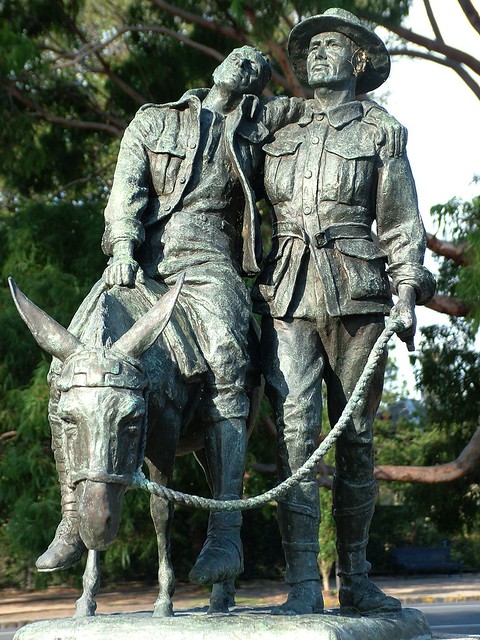
Like most Australian kids, I "did" Gallipoli in school every April. The dawn landing, Simpson and his donkey, the stupidity (or perfidy) of British command, Lone Pine, mateship, and bully beef tins attached to rifles for the evacuation combined to build a comprehensive picture of the ultimate ANZAC conflict.

So why was I surprised to learn that Robert died fighting in an Irish regiment a decade before anyone in that branch of the family ever contemplated moving to Australia?

I freely conceded that I knew less about the Somme — mud and weeks spent in trenches pretty much encompassed my view. The modern fascination with Villers-Bretonneux as an alternative site for Anzac Day commemoration had some association with the general area but I could not explain how.

That the momentous Battle for Mont St Quentin might rival Gallipoli for its significance in shaping Australian military lore and certainly surpasses it in terms of its impact on the course of the war did not cross my mind.

Learning that the battle in which Charles died was almost exactly the opposite of my naive preconceptions of the Western Front — short sharp skirmishes in which small groups operated almost autonomously moving rapidly over open ground — causes me to doubt many of the truths that I have always known(sic) about other historical events.

It is never too late to learn and there is no doubt that today I have a different (if not necessarily, a stronger) motivation. Yet, I cannot help but wonder what I would be missing if I were to regard genealogy as a form of philately and was happy simply to collect names and dates, while remaining blissfully ignorant of the fact that the past in which our ancestors lived and died is far more complicated that we imagine.

Friday, 19 April 2013

Ending a war

In April 1919, Australians were preparing for the first peace-time commemoration of Anzac Day. For many this would truly confirm the events of Armistice Day that had ended the War to End All Wars. But for some, the terrible war was far from over.

Our great grandmother Lucy COLEY must have felt mixed emotions when she signed for a package from Army Records Branch on 19 April of that year. It was another sharp reminder that it was just six months since her son, Charles Cephas COLEY, had fallen in the Battle for Mont St Quentin on the Somme. On the other hand, this promised to bring her "the effects of No 6421 Coley C.C." by which she would remember her cherished son.

Lucy was obviously a strong woman. The undeniable shock of finding military paraphernalia rather than his personal items sent her not to her bed, but to her writing desk. She dutifully acknowledged the delivery and enclosed the official receipt but then added the following plaintive postscript (spelled as she wrote it).

Could you please tell me if there is anything els belonging to this soldier comming to me, he had a good many things which he treasured & I would so like to have them for remembrance.

To the credit of the staff in Victoria Barracks, they responded promptly. On Anzac Day (which was not yet a public holiday) the Major in Charge of Base Records signed a reply indicating that another package had been located and would be despatched post haste.

On May 5, Lucy received the second parcel. This one contained "2 wallets, testament, notebook".

These simple items no doubt gave her greater comfort than either the medals forwarded in May 1921 or the Commemorative Scroll and King's Message that she was eventually to receive in December 1922.

Related Posts Plugin for WordPress, Blogger...