Showing posts with label Burton. Show all posts

Thursday, 25 October 2018

Granny was a perjurer

It may seem an odd admission for a family historian to make, but I was about ten years old before I recognised that most other kids had more grandparents than I did. It was not just that we did not see my father's parents, it was as though they had never existed. Naturally, as an inquisitive child, I set out to find why and quickly learned that this was another of those "things we don't talk about".

Advance half a century and I was able to show that my paternal grandparents married in Belfast in 1923 and separated approximately three years later. He migrated to north america: she brought their two sons to Queensland. Around the time of her divorce and remarriage in 1938, something happened between mother and son that meant that Dad never spoke a word to her again. Indeed, he tried to not acknowledge her as his next of kin1 when enlisting in 1941.

Those were the bare facts in the documentary records but (as is often the case) a newspaper can provide the context, the background and the colour that is absent from the official certificates. In my case, it was the report of the divorce proceedings in The Truth2 that revealed so much more. Readers familiar with the reputation of that paper may wonder at my apparent faith in its reporting, but as you will see it was most informative.

Christina (my grandmother) presented the facts of her case to show that after a few short years of marriage her husband had migrated to Australia and later sent the passage money for his family to join him. Joyously reunited in August 1928, they lived at Sandgate apparently in domestic bliss until November 1928 when he mysteriously vanished without a trace. From that day hence, she had neither seen nor heard from him.

His Honour was clearly concerned by some minor details, such as the plaintiff's inability to recall where her husband had worked in Sandgate.

 "It is a most extraordinary story you are telling me" [Mr Justice Henchmann] remarked to which Mrs McAllister replied "Well it is true".

It is the case that (as in all extravagant fantasy) there are grains or perhaps wisps of truth woven into the tale, but there are even more elements that are demonstrably false.

My grandfather had left Belfast on 13 November 1926 aboard the S S Regina bound not for Brisbane, Australia but for Montreal, Canada3. That this person was the correct Robert Joseph McAllister is shown by the notation on the ship's manifest4 that he intended to be joined (eventually) in his new home by "Mrs C McAllister (wife 24 years) Robt J 2¾ Andrew B 1½".

The cost of the voyage to Brisbane by Christina, Robert, and Andrew aboard the Demosthenes was met not by Mrs McAllister from funds remitted by her husband but by the Queensland Government5 (and the Salvation Army). In correspondence on her migration file, Christine acknowledged that as a deserted (sic) wife unable to locate her husband in Canada, she needed financial assistance to join her sisters (who had made the journey to Brisbane earlier).

Upon arrival in Queensland, Christina lived not in Sandgate but at Stones Corner6 - a short walk from her address at the time of the divorce. And she remained in that general locale for the rest of her life.

In short, neither party had ever lived in Sandgate and the "missing" husband had never set foot in the country. But Mrs McAllister wanted her freedom.

There were other extravagant claims in Christina's evidence (possibly incorporated to add artistic verisimilitude to an otherwise bald and unconvincing narrative) that seem so absurd as not to warrant investigation. In total, the obvious inconsistencies apparently disturbed the presiding judge who made one last attempt to understand the situation

... and yet he left you and his children. Was he fond of them?" "He did not take much notice of them" Mrs McAllister answered.

The decree nisi was granted along with an order for the custody of the two boys. In December 1937, Christina remarried and my father (aged 13¾ years) left home.

While it is undeniable that much of the evidence given in the case was false and its reporting sensationalised, that newspaper report answered a very important question for me.

The worst offence that I could commit in the eyes of my father was not to admit to a misdeed. I must always be truthful and "own up" to what I had done. And never, ever try to shift the blame for my actions onto another person.

My father would not want me to associate with any person to whom the terrible label LIAR could be attached. She Such a person could cause untold hurt to others and should be shunned.

Sources
  1. RANR Record of Mobilised Service NAA: A6770, MCALLISTER R J
  2. DISAPPEARED AT HIS SECOND ATTEMPT Truth 31 May 1936: p 12
  3. Outgoing Passengers UK BT27/1110/4 Regina
  4. Immigration Records (1925-1935), Canada Robert J McAllister 1926 vol 24 p 116
  5. Queensland State Archives Item ID1120524, Files - immigrant McAllister, Christina
  6. Queensland, Australia, Electoral Rolls 1934 Christina McAllister Griffith, Buranda

Thursday, 15 September 2016

What do you think they did?

A few weeks ago the Ireland XO site posted an interesting piece on the theme what did your ancestors do? I was amused to read of some of the more outlandish job titles. I do not have a flax scutcher in my tree: my lot seemed to be predominantly linen lappers.

But I was disappointed not to find any mention of the job title that has been puzzling me lately. Our 2xgreat grandfather Andrew Burton was described in 1905 as a "coal trimmer". In 1890, Andrew had been a stonemason. Was this new trade a highly specialised craft that drew on his expertise working with stone to ensure that the fuel fed into a furnace was neat, or at least uniform in size?

It turns out that at the turn of the twentieth century, coal trimmer was a well-recognised (and very important) maritime occupation with a very misleading name. They should have been called ship trimmers. A ship might steam out of harbour looking very seaworthy with its bunkers loaded with coal. But if all the coal stored on the port side of the vessel was fed into the boilers before any was taken from the starboard side, the ship would become very unstable and could easily roll over and sink in even a mild sea.

black gangIn order to keep the vessel on an even keel, also called "in trim", a group of men were occupied around the clock redistributing coal within the hull to ensure that all the forces remained in balance. Despite the disastrous consequences of any failure in their work, the coal trimmers were regarded as being less skilled than firemen or stokers (fellow members of the Black Gang) and were among the lowest paid on the ship for working in the most difficult conditions.

So Andrew was not making fine technical adjustments to fuel quality in a new high-technology environment, as I had optimistically imagined. He was shovelling tons of rock in near pitch black and choking dust alongside the boilers that could make the metal bulkhead glow red.

When he listened to the preaching at the Salvation Army Citadel on the torments of hell awaiting the unrepentant, Andrew Burton must have understood quite literally what was being described.

Saturday, 31 January 2015

Relevance is relative

I thoroughly enjoyed the opportunity to hear Chris Paton speak when he was in Australia in February 2014; and I am an avid reader of his books. But even I baulked at the extended treatment at the beginning of Discover Scottish church records of the web of schisms and reunions in the non-conformist churches.

As I flipped over to find "something more useful", I pitied any poor researcher who actually needed to work through that section because he had family involved in one of those sects.

I think the relevant expression is don't speak too soon.

Close examination of the registration details for the wedding of (2xgreat grandparents) Andrew Burton and Agnes Cameron on 28 October 1887, show that the ceremony was conducted by William B Gardiner according to the forms of the Original Secession Church.

So I am now elbow deep in the arcane distinctions between episcopalians and presbyterians, burghers and anti-burghers and the auld and new lichts.

I apologise Chris. I should never have doubted you. At least I remembered whose book it was that I had not read properly.

Friday, 23 January 2015

Could Andrew Burton read and write?

On the occasion of his wedding to Agnes Cameron (on 28 October 1887), our 2xgreat grandfather Andrew "signed" the documents by making his mark. Younger brother James and John Renfrew counter-signed to confirm that the groom was who he claimed to be. The Registrar, Mr Barrowman, duly recorded this in the Statutory Register. This was a distinct role for James apart from being a witness to the ceremony as a whole, which duty he shared with Agnes's sister Isabella (as recorded in another part of the Register).

Universal literacy is a relatively modern idea but Andrew's status is puzzling. He grew up in Ireland in the 1870s (when their school system was regarded as a model for the colonies in Australia) and moved to Scotland which also was justifiably proud of its educational provision. Apparently James, just 4 years younger, was able to read and write effectively. What could be the reason for Andrew's inability to sign his own name?

The situation is complicated when the birth records of Andrew's children are considered. The 1889 entry in the Register for Sarah Anderson Cameron Burton (also overseen by Mr Barrowman) includes a signature, apparently made by the father. The 1893 entry for eldest son Robert (once again recorded by Mr Barrowman) includes the very same signature.

It is not a stylish hand, but the penmanship is consistent and serviceable. (It is possible to think of one or two modern descendants whose handwriting is no better!) Had Andrew learned to read and write in the years following his marriage or at least been trained to make a more sophisticated "mark" that would avoid embarrassment in a society where literacy was expected?

An alternative explanation might be that Andrew's action on his wedding day was the result of a temporary condition. Might he have injured his fingers while working in the quarry so that he was unable to control the pen? Or was he suffering from another ailment on that day that impaired his faculties? Was it significant that the ceremony was conducted at the bride's home (42 Rosendale Road) rather than in the kirk?

The absence of conclusive evidence is often a source of frustration for family historians. On the other hand, it does leave room for speculations that are imaginative, amusing or outrageous (according to your point of view).

Wednesday, 7 January 2015

Money well spent

We know that money cannot buy happiness but, judiciously applied to the purchase of just the right certificate, it can dispel a whole lot of family history gloom.

When our 2xgreat grand grandmother Agnes Burton died in Queensland in 1937, her parents were recorded as John Cameron and Agnes Anderson.

There was no reason to doubt this information since Agnes had at least four adult daughters living in close proximity who would have collaborated on the task of registering her death.

Confidence in the veracity of these claims has been shaken by an extended period of trawling through transcriptions of Scottish censuses without locating one plausible candidate for this Cameron household. There was just one course of action left. I hesitantly opened my (digital) purse and paid ScotlandsPeople to view the record of the marriage of Agnes to Andrew Burton. This revealed the bride's parents to be John Cameron and Sarah Anderson!

Naturally, locating the relevant census records took a matter of moments with the correct names. And then the implications of the new information began to flow. The full name of Aunt Sally (Sarah Anderson Cameron Burton) now made perfect sense and reminded me not to forget the naming convention when facing a Scots brick wall. Was this further indirect evidence that Sally's younger sisters may not have known their grandmother? Did Agnes Cox simply assume that, because her name was Agnes and her mother was Agnes, her grandmother was also?

Family historians need a healthy streak of scepticism. We must remember that it is most important to bring it into play precisely when there seems "no reason to doubt". Trust no-one and examine the documents. It might be £1.20 well spent.

Thursday, 15 August 2013

A sad tale retold

Family historians always get excited about finding a new source. At worst, you can cite some further support for information that you already have. At best, there may be completely new evidence to add to the narrative of your ancestor.

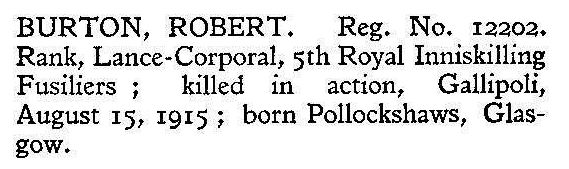
As the anniversary of the death of Robert Burton at Suvla Bay approached, I have been reviewing what (little) I know about his military career. In the course of that search, I came upon a report of IRELAND’S MEMORIAL RECORDS 1914-1918: Being the Names of Irishmen Who Fell in the Great European War 1914-18

This very beautiful, but very expensive, publication was described as being a "Roll of Honour listing over 49,000 of Irish birth or residence at the time of death, who served and died during the Great War, compiled by The Committee of the Irish National War Memorial with Decorative Borders by Harry Clarke". In the early 1920s, £5,000 of Ireland's War Memorial funds was spent collecting the records of over 49,000 fatal casualties and publishing them in eight volumes. The men and women commemorated either served in Irish Regiments or were born in, or resident in, Ireland at the time of their death serving with units from Britain and its empire.

For those without the several hundred euro required to purchase a hard-bound set of the books, digital images can be viewed on Ancestry or FindMyPast. There I found the entry for Robert Burton. Sadly, it provides no new information.

A young man marched away bravely in search of adventure; never to return. However exquisitely the page may be decorated, everything else is emptiness.

Thursday, 15 November 2012

A soldier's Will

Until yesterday, all that I knew about Robert BURTON (the eldest brother of our great grandmother Christina) was contained in my post Not just ANZACs describing his death at Suvla Bay.

Now I have on my screen an image of his informal will made on a page of his official notebook left blank for that purpose. In truth it tells me nothing more than I already knew, but it is written in his own hand and carries his signature.

The National Archives of Ireland has made available for searching 9,000 wills of enlisted and non-commissioned soldiers from the thirty-two counties of Ireland who fought in the British Army in the World War I and in the South African war of 1899-1902. There were more than 35,000 Irish deaths in that period, so there will be many disappointed searchers.

Thursday, 8 November 2012

A broken family

Our great grandfather, Robert Joseph McALLISTER was born in Belfast in 1902. He married Christina BURTON on New Year's Eve 1923. They had two sons, Robert (b 1924) and Andrew (b 1925).

On 13 November 1926, Robert Joseph McALLISTER set sail for Canada on the SS Regina. The family would never be together again.

Christina's version of events is contained in a statutory declaration made in March 1928 to support her application to enter Australia with the children.

My husband the said Robert Joseph McAllister deserted me and emigrated to Canada in the month of November 1926 ...

Robert's view of the separation can be seen in the passenger list of the Regina where he responded to following instruction

by entering
Mrs C McAllister (wife 24 yrs),
Robert J. 27/12 Andrew B. 11/12,
32 Toronto Street Belfast

Which version is true? In the Queensland Immigration files there is an copy of a letter dated 14th March 1927 noting that "... nomination of Christina McAllister and family has been cancelled, as they are proceeding to Canada".

None of this was ever the subject of conversation within the family. The ramifications of the breach were such that Robert (the son) never spoke a word to his own children about either of his parents or his brother. A line had been drawn under an unhappy past that was not to be revisited.

Friday, 5 October 2012

Lost streets

Despite its name, much of family history is actually concerned with geography. Knowing when your ancestors did something is much richer when you know also where the event took place.

Many of the documentary records that we use provide very detailed spatial information. Upon finding an address with house number and street name, the first thing that a modern family historian will do is to enter that information into Google Maps.

If we are fortunate, Street View will allow us to look for the ancestral home without ever setting foot outside our own front door.

Of course, there will be times when no match can be found in the Google Map database. Perhaps through wartime damage or more recent urban renewal, the old street has gone forever.

When confronted with this situation, I was about to close the file and move on when I decided to run the address through Google Search. Perhaps there might be a link to an old document that mentions it and other streets in the same neighbourhood that would allow me to identify a general area even if the precise location is unknown.

What I found was a magnificent service offered by the Glasgow Guide. On their website they have a table that cross-references "lost" or changed street names and their modern replacement or equivalent.

Armed with the knowledge that Ure Street has been renamed to Uist, I could easily go back to Google Maps and view the area. Even after more than a century of changes (and some obvious gentrification), it is possible to get a sense of what life might have been like tucked between the docks, the industrial estates and the main road.

How wonderful it would be if all local authorities were to make public a list of street changes. Thank you Glasgow Guide .

Friday, 28 September 2012

Signing the Ulster Covenant

Today marks the one hundredth anniversary of the signing of the Ulster Covenant. Around the world on September 28th 1912, half a million people recorded their opposition to the prospect of a Dublin-based Home Rule parliament for all of Ireland. (Strictly speaking a quarter of a million signed the Covenant, and the rest (the females) signed a Declaration framed in similar terms.)

The centenary reminds us of the irony that a country with the least full-population data has two extensive sets collected just 18 months apart. Much can be learned by comparing the returns of the Census taken on Sunday 2 April 1911 (one of only two surviving) with the information provided by signatories to the Covenant or Declaration.

Take as an example our 2xgreat grandmother, Agnes BURTON. In 1911, she was one of seven people of that name recorded on the Census.

In the following year, just four Agnes Burtons signed the Declaration. Can they be matched to individuals in the Census?

The first address (in Tennent Street) seems to be in both data sets but the house numbers are different. Had Agnes moved from number 11 to number 235 in the intervening year? In fact, she did. Her daughters (Isabella and Mary Ann) included on the Census return also signed the Declaration and gave the same new address.

Lindsay Street is even more straight forward. The house number matches and apparently the family was still in residence. But Agnes was the only signatory from that household. Had Mary (aged 24 at Census time) married or left home for another reason? Of course, it is possible that Mary was still at home but declined to sign (which would have created some fascinating dinner conversations!).

The other address in Belfast South (Tassagh Cranmore Park) does not appear in the Census list but there was an Agnes living in the Windsor Ward at 109 Marlborough Park. She had three adult daughters—Winifred, Alicia and Mary. Each of them signed the Declaration and gave addresses in Cranmore Park, but only the youngest Mary was more specific listing the house name(?) Tassagh when she signed immediately under Agnes. Winifred and Alice appear to have signed at a different Meeting Hall.

All of which leaves just one signature to be reconciled; that of the resident of Finmore Street, Pottinger. Was she the other Agnes from Co Antrim, from Co Down, or Co Monaghan?

Agnes from Ballynure Street, Clifton in Antrim was the only one of the seven to list her religion on the census as Church of Ireland (the established Church) and so might be thought less likely to be a supporter of the Covenant than the non-conformists.

Lurganmore in Co Monaghan is a considerable distance (more than 90 minutes drive) from Belfast. If this Agnes was now resident in Pottinger, then it required a major relocation. When you consider that her son James (recorded on the same Census form in 1911) signed the Covenant at Drumgart Hall (in Monaghan), this seems unlikely.

You will note immediately that the two Agnes in Co Down lived at the same address, St Leonard's Street, in 1911. 19-year-old Agnes is our 2xgreat aunt, the daughter of 42-year-old Agnes.

The PRONI database shows that 3371 people signed one or other of the documents at Westbourne Presbyterian Church. Of those just six lived in Finmore Street. Agnes Burton resided with Sarah Nelson at number 6. If there were other adult residents in that household, they apparently were not signatories.

Although the area near the Belfast shipyards has been redeveloped after World War II bomb damage, there is a Finmore Court just two minutes walk from St Leonard's Crescent. Are these the addresses referred to in the century old records? Did Agnes (presumably the younger) move out of home (but not too far) soon after the Census?

It would be useful to be able to explain why Agnes (a member of the Salvation Army) chose to sign the Declaration at a Presbyterian Church. Was Sarah Nelson a member of that church? In 1911, there were four Presbyterians by that name aged between 18 and 28. One was a flax spinner and another a linen weaver, working in the same industry as "our" Agnes.

So the circumstantial evidence that our ancestor signed the Declaration is strong. Will the signatures provide the definitive evidence?

Clearly the person who 'signed' the 1911 Census is not the one who signed the Declaration.

But what about the person who 'completed' the Census?

In the absence of further evidence, I will assert that the younger Agnes filled in the form that was signed by our great great grandmother in 1911 and then signed the Declaration in her own right the following year.

What do you think?

Thursday, 30 August 2012

Weaving a tale

Our family has a long association with the fabric industry. In 1861 4xgreat grandfather, Tom GALBRAITH listed his occupation in Paisley (Scotland) as "plane weaver" and most of his children entered the family trade.

In Belfast in 1911, Tom's grand-daughter (our 2xgreat grandmother) Agnes CAMERON worked as a "Linen Weaver" while her daughter Agnes BURTON (aged 19) was a "netter" and son Andrew BURTON (17) was a "machine boy".

At that time, the flax and linen industries were responsible for a significant part of the prosperity of Ulster (and Belfast in particular). The handy tourist guide McCormick's Historical and Descriptive Guide to Belfast and Neighbourhood 1907 (available at the Family History Books site) provides the following information.

"The fame of Belfast linen, like that of Belfast ships, is world-wide. Nowhere else can it be turned out with the same snowy whiteness or such fine texture, and the skill of our manufacturers is considerably aided in producing the finished article from the raw fibre by our humid climate, which assists the bleaching process. The manufacture of linen is our staple industry, and but for the linen business, Belfast would today in all probability be a town of minor importance."
"YORK STREET SPINNING MILL. — This mill, which is said to be the largest in the world, is a sight no visitor should miss. It is situated near the foot of York Street, convenient to the Midland Railway terminus, and extends from York Street to North Queen Street. ... Over 5,000 persons are employed in the vast factory, which is 786 feet by 221 feet, and covers an area of four acres."

As with any highly-developed technology, the linen industry in Belfast created some specialised occupations. When applying to migrate in 1929, Susan BURTON wrote that she was employed as a handkerchief "Box Folder and Ornamenter" but was prepared to seek employment as "Anything" in Queensland.

Like many others demobbed from war service, grandfather Robert Joseph McALLISTER drifted through a number of jobs; but his entry in the 1949 Electoral Roll shows that he had returned to his roots as a "clothing machinist". Just how he moved from that to "economist" is a tale for another day.

Wednesday, 15 August 2012

Not just ANZACs

Today marks the 97th anniversary of the death at Suvla Bay of Lance Corporal Robert Burton of the 5th Battalion Royal Inniskilling Fusiliers.

Robert was the older brother of our great grandmother Christina BURTON, born in Lanarkshire Scotland in 1893. The family returned to his father's home of Ulster in the early 1900s.

The Fifth (Service) Battalion of the Fusiliers was formed at Omagh in August 1914 as part of K1 (Kitchener's First Army of volunteers created to replace the professional army that had begun the War). The 5th and 6th Inniskillings made up part of the 10th Division, the first ever all-Irish Division, that moved to Dublin then by early 1915 was at Kildare. In April the Division moved to Basingstoke in England before leaving for the front.

The Inniskillings (known as the Skins) landed at Suvla Bay, Gallipoli, on 7 August 1915. They were in the second wave of an attack that began the night before to support a planned breakout from the Anzac sector, five miles (8 km) to the south.

Like most plans at Gallipoli, it foundered and the troops were trapped on yet another beach.

On 15 August, British units advanced against the Turks dug in on Kiretch Tepe Ridge. Little progress was made and the attackers suffered more than 2,000 casualties.

That same day, the British commander at Suvla, Lieutenant-General Sir Frederick Stopford was dismissed. The change came too late to save Robert BURTON. His last resting place is unknown but he is remembered on the Hellas Memorial that sits on the end of the Gallipoli Peninsula.

Sunday, 12 August 2012

Where was Bill?

Locating a new authoritative data source, such as a Census record, gives you the opportunity to cross-check what you already know (or assert) about your ancestors' approximate age, residence, occupation, religion and education. If you are lucky the new information confirms what you have been claiming.

If you are very lucky, the Census record contains an anomaly that challenges what you believe and opens up a new line of investigation.

That was the case with the 1911 Census of Ireland for the Burton household at 64 St Leonards Street, Victoria in Belfast.

It confirmed that Agnes was then a widow after the death of 2xgreat grandfather, Andrew and that her oldest daughter Sarah had left home. Those of working age were employed in flax-related industries and the five youngest children were in school — Andrew, Isa, Chrissie, baby Daisy (Susan), and … Bill was missing. William BURTON, aged 5, was not at home on census night 1911.

The records of the Belfast General Cemetery reveal that there was an horrific number of infant deaths between 1890 and 1910; but we have photographic evidence that William BURTON was not among them.

A number of suggestions were put forward as to where Bill might have been — in hospital, staying with his older sister, even the very modern possibility of a school camp. The challenge then was to use the census to find him.

Thanks to Agnes' practice of going "home" for each birth, he should be easy to track down. How many 5 year old boys called William born in Scotland and adherents to the Salvation Army could there be in County Down? In fact there were none recorded. Sometimes elegant searching needs to give way to brute force.

How many males aged 5±5 years named Burton were there? Just 15, of whom seven were 3 years old or younger and two were 8 years or older. Of six boys aged 4 to 7, three came from Presbyterian families and two were Church of Ireland.

Which left Willie aged 5 recorded as having been adopted into the Salvationist family of James and Mary Burton of 6 Gawn Street, Victoria.

Why do I think it is plausible that this is William the son of Andrew and Agnes Burton? The match of his name and age are not compelling evidence alone but, when you add the religion and the fact that the two houses are located just a few minutes apart, the case builds. Most significant is the fact that James' occupation "labourer" has been annotated "ship yard". I believe that Andrew was also working in the ship yards at the time of his death.

When Agnes was widowed, she was pregnant and had toddlers of 6, 4 and 2. If the family of her husband's workmate from the same Temple offered to look after one of the young boys, would she have accepted?

The case would be almost complete if I could demonstrate a family connection as well as occupational and religious links. Andrew Burton did have a brother James but he was born in 1870 and so would have been 41 years old in 1911 not 49.

However the damage to my argument is lessened somewhat by the observation that at the previous census (in 1901), James had claimed to be 45 years old. In the same ten year period, his wife Mary aged only 2 years and daughter Lizzie 7 years. The ages of the Irish on official documents need to be interpreted flexibly!

On balance, I am comfortable claiming that in 1911 Bill was living with his Uncle James and family just a few streets away. He was certainly reunited with his siblings in Queensland where they followed the same practice of village-like life — living with walking distance of each other's homes and being very flexible about whose children stayed where at any given time.

And that is where this story will stand, until I am lucky enough to find a piece of evidence that makes me search in a completely new direction.

Thursday, 19 July 2012

How many of us are there?

As you turn back from researching a blind alley after finding that yet another person is not the ancestor you are seeking, you might be inclined to say "Well at least we don't have any Smiths in our tree." Which prompts the question How common are the surnames of our family?

There are a number of websites that enable you to compare the occurrence of a particular name across countries and (in some places) within a single country. The World Names Profiler enabled me to look for BURTONS across the world and within the United Kingdom.

This site reports a measure of FPM (frequency per million people)and other mapping tools provide similar. But it is rare to find one that exposes the underlying raw data.

For the United States, FindTheData does just that, by drawing upon the Social Security Administration database. At first glance, you appear to be limited to searching on one name at a time. However, the "Compare" button in the results allows you to collect the data on up to ten names and view them as a table or in various charts.

With a little copying and pasting into a spreadsheet, I was able to extract data on each of the 30 unique surnames that occur in 6 generations of our tree and create a column chart showing how many US citizens share them with us.

While the ANDERSON name clearly dominates, there are 11 more popular surnames in the database. (For every Anderson, you can find 30 American Smiths. "Well at least we don't have any Smiths ... )

Considering our geographical origins, we find a top ten made up of:

  • a Scottish group Anderson[1] Cameron[6]
  • an English group Cook [2] Lloyd [4] Wilkins [5]
  • an Irish group Burton [3] McAllister [10]
  • a German group Kuhn [8] Cramer [9]
  • and one Welsh name Davies [7]

Restricting the data to the 8 surnames found in 4 recent generations, the chart looks like this.

I was surprised that there is not a single entry for SUDDABY in the US database. Hidden in the scale of the first chart is the fact that there are no MEDWELL, HEATHWOOD or BARGH either.

On the other hand, the raw numbers for even the low frequency names are huge. More than 9000 NOYES would create quite a few blind alleys to explore. In moments of frustration, perhaps we should say "Well at least we aren't working on the USA."

The ready availability of all these American data highlights the apparent difficulty of obtaining comparable information on surname frequency in Australia. The site British Surnames has a list of the 100 Top Australian Surnames that suggests raw data may be able to be extracted by someone sufficiently determined. But that may have to be a task for another day.

Tuesday, 19 June 2012

Home is where...

In a world where international travel is so easy and migration common-place, the concepts of residency and even citizenship have become fluid. The nationality with which one identifies, however, tends to be more firmly fixed.

Andrew BURTON (our 2xgreat grandfather) was born in Ireland in 1866 but moved to Scotland with his family and in 1887 married Agnes CAMERON there. The 1901 Census shows them resident in Glasgow with several children.

By the 1911 Census, Agnes and more children were living in Belfast. At some time in the intervening years, Andrew had died and the family had travelled back to Ireland (but not necessarily in that order). Investigating the dates and places of birth of the younger children led me to belive that the move occured between 1907 and 1910 after his death.

I tested my theory in conversation with an older cousin. He told me I was completely wrong. The shift was much earlier than that and Andrew died in Belfast. But Susan was born in Scotland, I insisted.

"Oh, they all were. Whenever Grandma was near her time, she caught the ferry home to have the baby. That way she made sure that all the kids were Scots!"

Little wonder then that when Agnes applied to migrate to Australia, after a quarter century of living in Belfast, she listed her nationality as Scot. And so did every one of her children!

Our (then four-year-old) grandfather Robert McALLISTER was also identified as a Scot despite having lived all his life in Belfast and having an Irish father who was then resident in Canada. But that is a far more complicated story.

Footnote: Actually Agnes has to nominate herself as Scotch not Scots (after all it was an Australian form).

Related Posts Plugin for WordPress, Blogger...